Ontology platform

Talaria

A sovereign industry begins with mastering its supply chain.

Data has multiplied. Every order, every receipt, every inspection leaves a trace in a different piece of software: the ERP, purchasing, quality, contracts, supplier files. Each keeps its share of the truth. Reconciling them remains largely manual, and a failure at a tier-2 or tier-3 supplier is often discovered when the line stops.

Talaria is an ontology platform developed and hosted in France. It reads your data where it is, read-only, and connects it into a digital twin of your business: your sites, items, suppliers and contracts, linked to one another down to tier 3. On this model, every question gets a quantified, justified answer. A person decides every action. Talaria then prepares the file and records the decision.

Systems holding your data: ERP, purchasing, quality, contracts, files

Scattered

Visibility on suppliers beyond tier 1

Partial

Reconciling data before each decision

Manual
Talaria connects your whole business

Talaria reads each source, turns it into objects of your business and links each one to what depends on it. A single question then runs across your purchasing, stock, production and contracts.

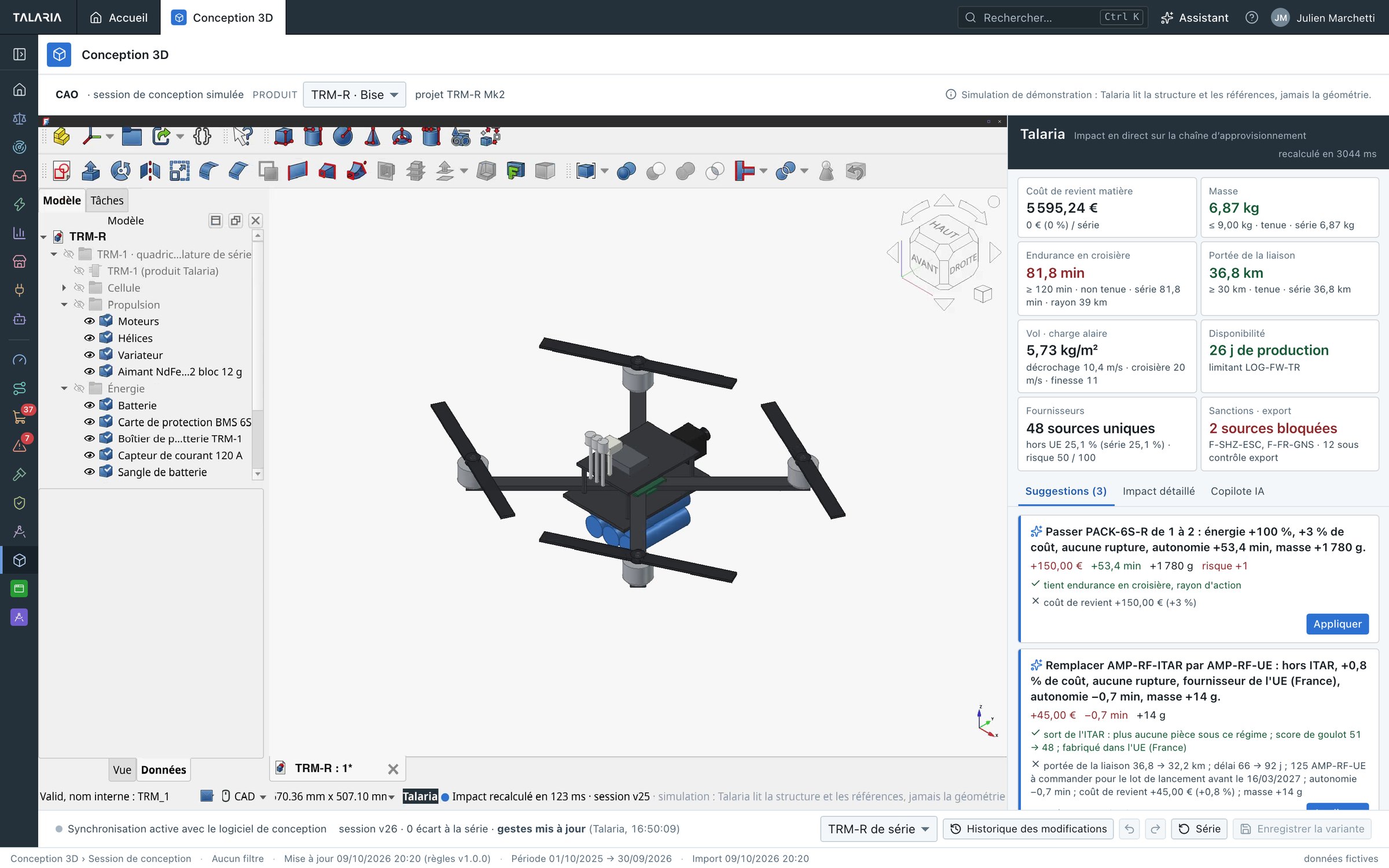
  1. Talaria plugs into the software you already use, ERP, PLM, design, maintenance, and the ontology works with you, inside your own tools.

    What you see

    In your design tool, every part of the model is linked to the supply chain: cost price, mass, suppliers, production lead time, export-blocked sources, recomputed with every change.

    What you do

    Talaria proposes alternatives, a more available part, outside export regimes, made in Europe, with their effect on cost and performance. An approved action becomes a write proposal that you execute in your ERP.

    What it changes

    Design, purchasing and production decide with the same figures. Talaria reads structure and references, never geometry, and nothing is written to your systems without your approval.

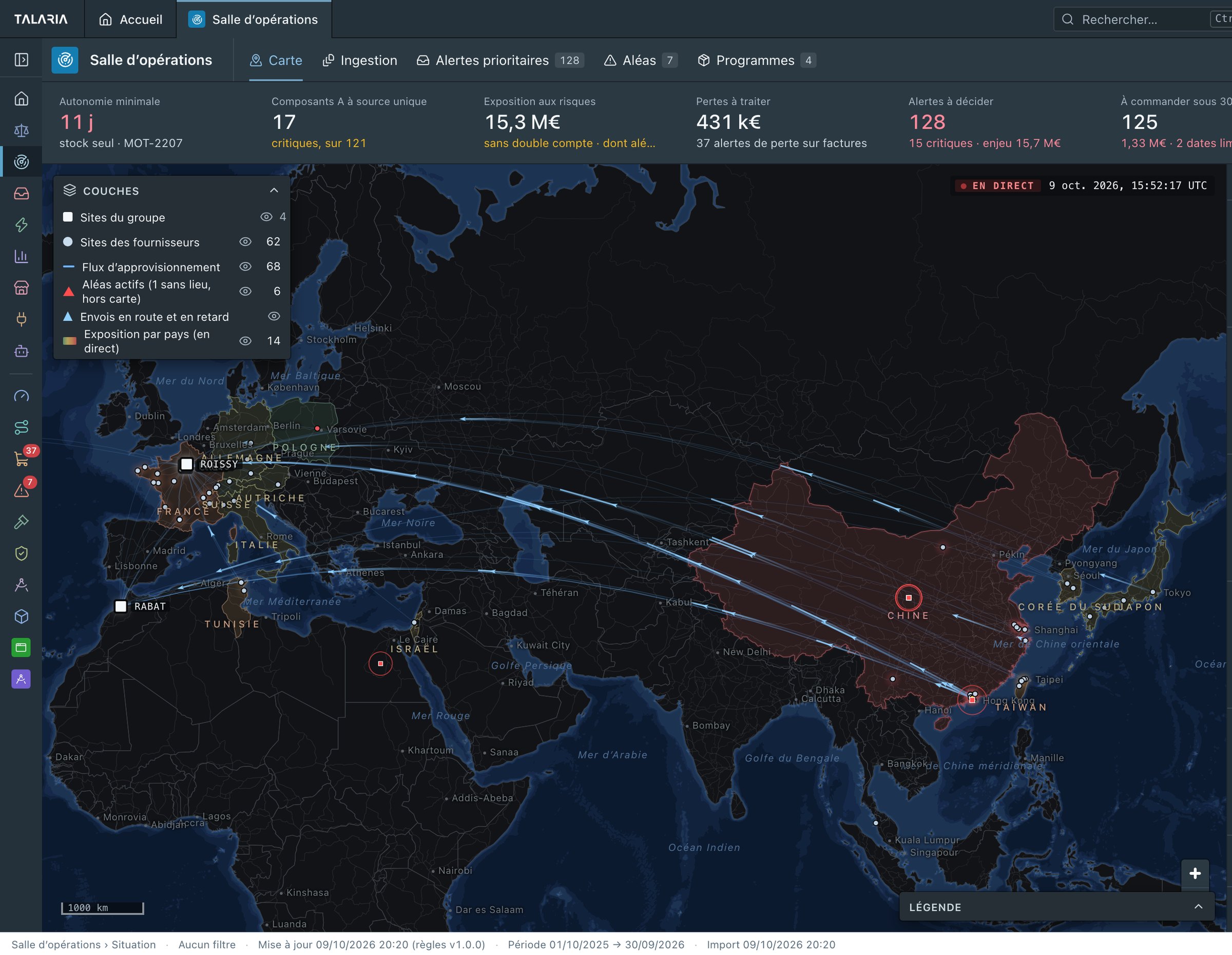
  2. The situation of your whole chain on one screen, shared by purchasing, supply chain and management.

    What you see

    Your sites, your suppliers, current flows and the disruptions affecting them. Alerts are ranked by what is at stake, in euros.

    What you do

    You open an alert and follow what it affects, from the part to the site, then to the customer order.

    What it changes

    Everyone looks at the same thing at the same time. What costs most is handled first.

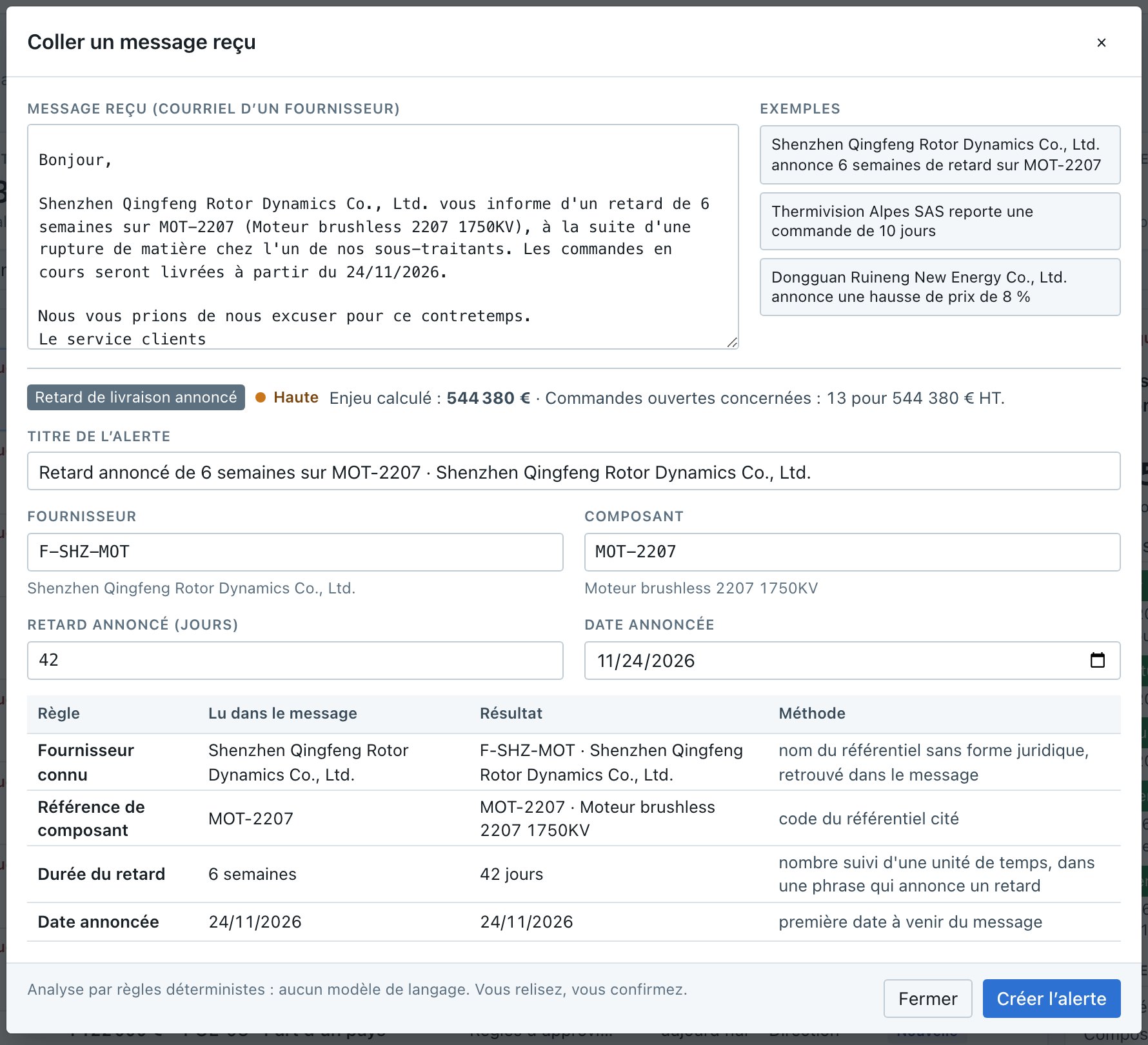
  3. All the group’s exceptions arrive in a single queue, already quantified.

    What you see

    A delay announced by a supplier becomes an alert: the orders concerned, what depends on them, what the delay costs.

    What you do

    The rules you set handle the simple cases. You decide the exceptions, with the full context in front of you.

    What it changes

    No more emails lost between departments: each alert has an owner and a follow-up.

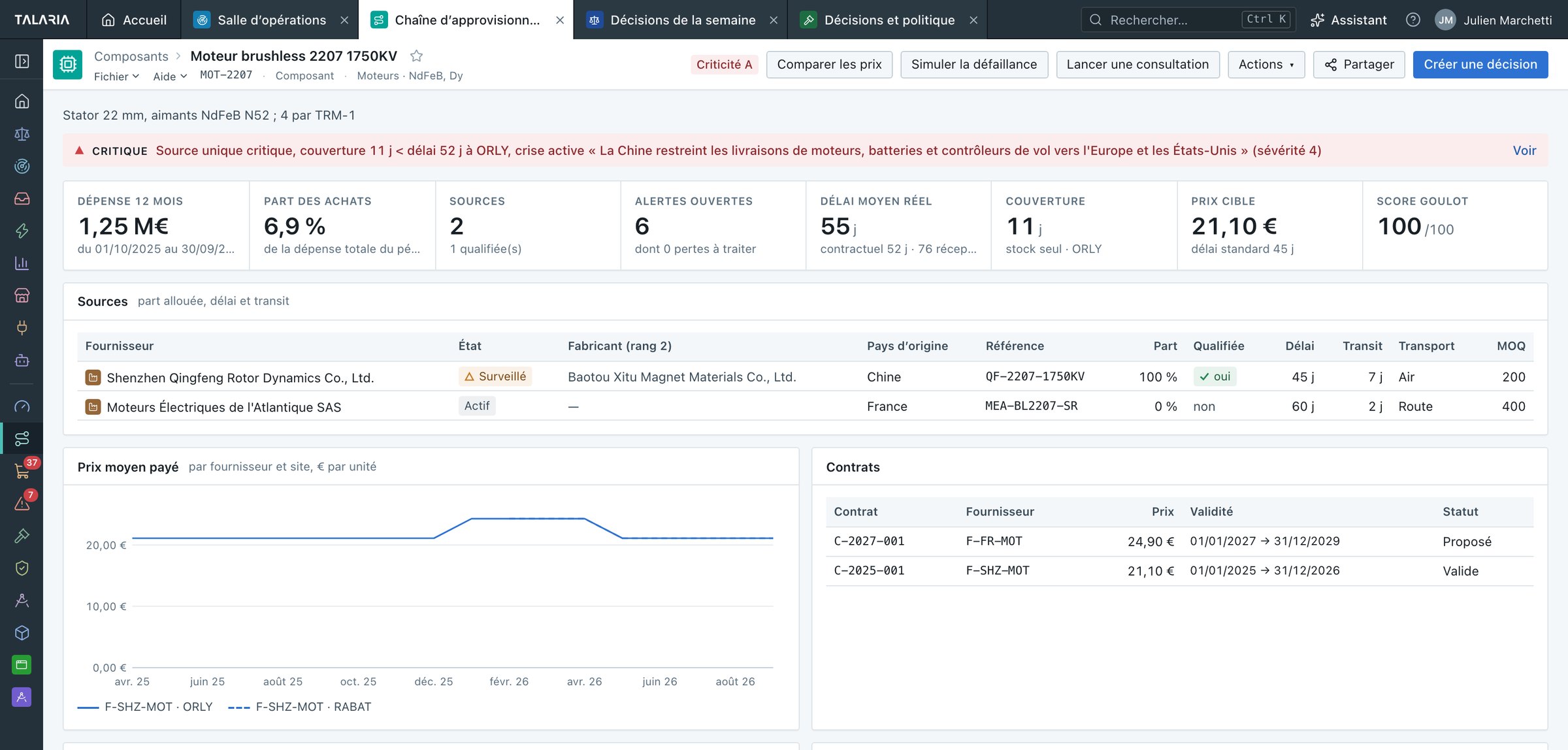
  4. Everything there is to know about a part, gathered before acting.

    What you see

    Its sources, the prices paid, current contracts, stock coverage site by site.

    What you do

    You compare sources, check what the contract provides, see where stock can be moved.

    What it changes

    A question that took three departments and a week fits on a single record.

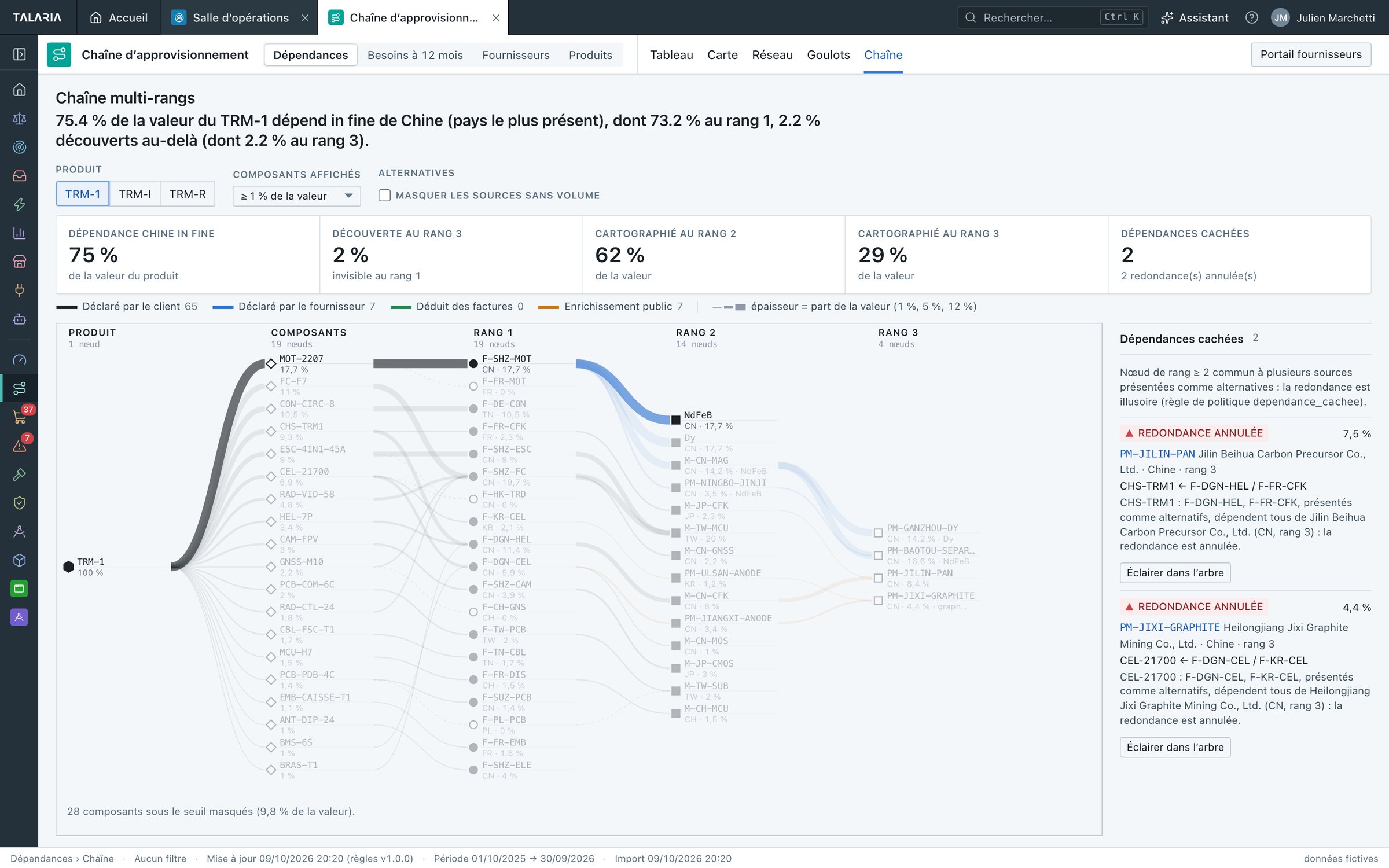
  5. What depends on what, beyond your direct suppliers, down to raw materials.

    What you see

    Tier 2 and tier 3 dependencies, with each link marked as declared, inferred or still unknown.

    What you do

    You trace a part back to its material and document what remains unknown with your suppliers.

    What it changes

    A hidden dependency shows up before the crisis, not during it.

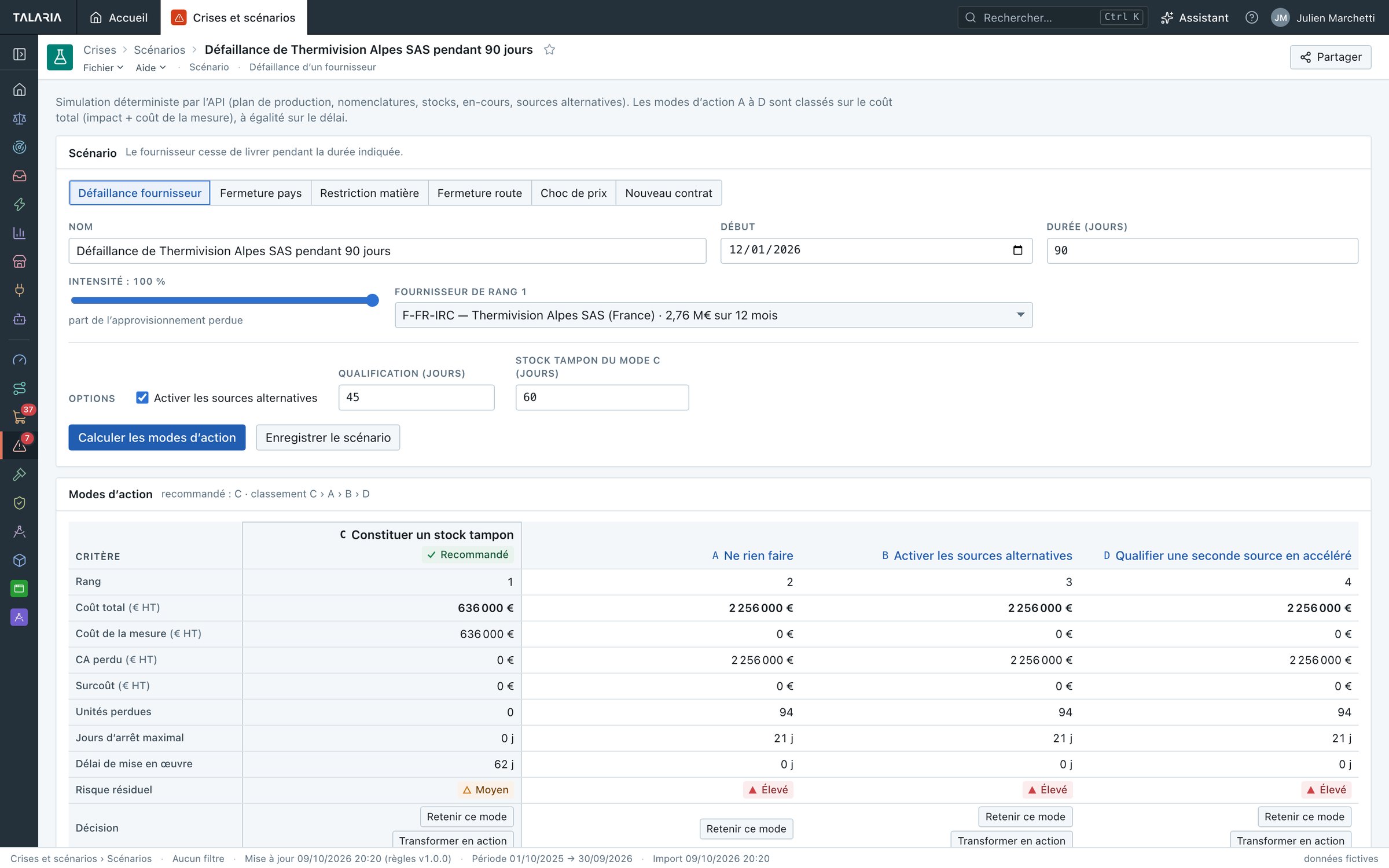
  6. Each possible response is computed and compared before it is chosen.

    What you see

    A failing supplier, a closed country, a restricted material: the options side by side, with their assumptions and worst case.

    What you do

    You choose the assumptions, adjust a lead time or a volume, and see the effect on your orders.

    What it changes

    Decisions rest on justified figures that anyone can review.

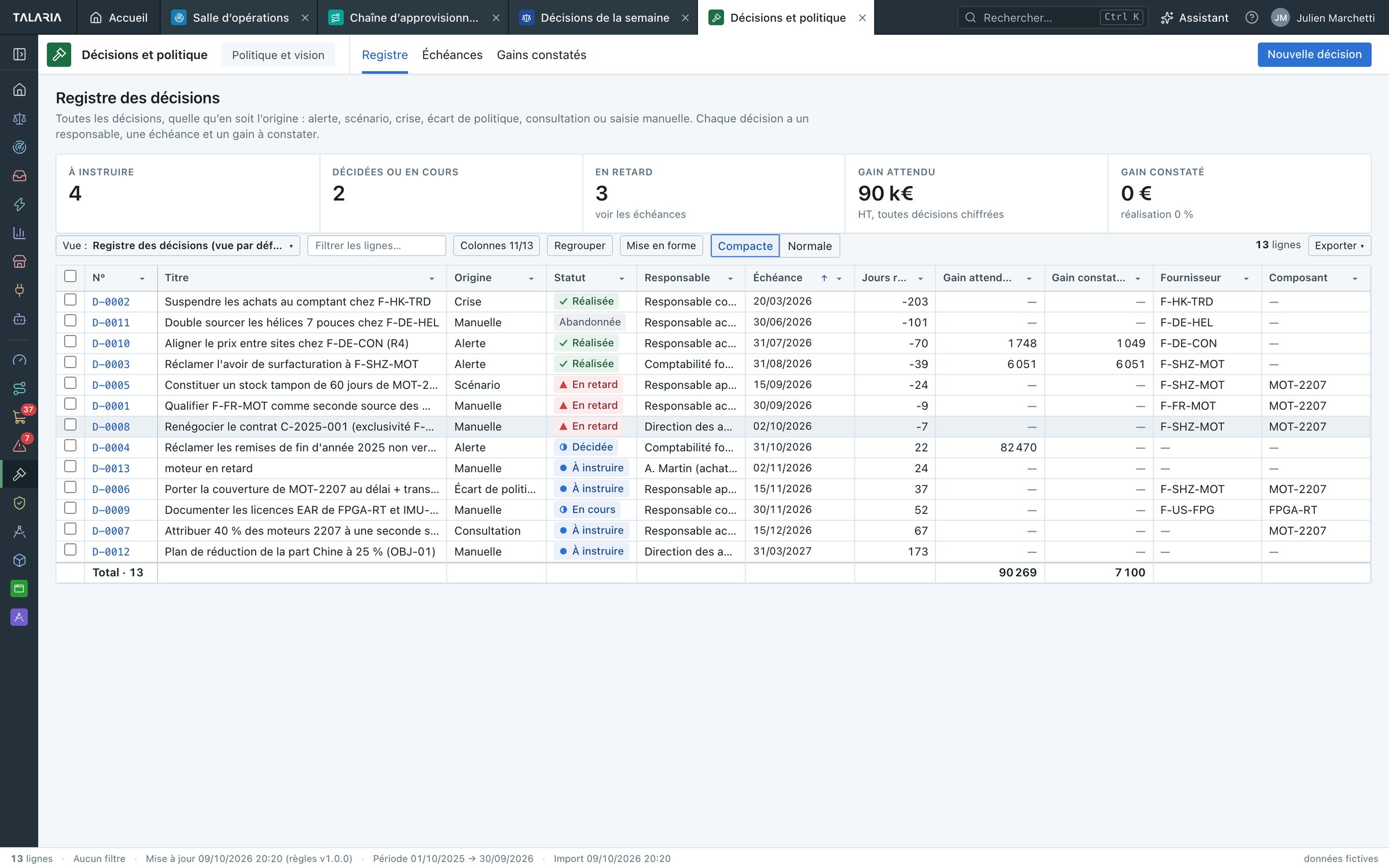
  7. Talaria recommends and says why. People decide, and the decision stays.

    What you see

    Each decision with its options, its reason, its expected then observed gain.

    What you do

    You approve through your usual circuit. Nothing changes in your systems without your approval.

    What it changes

    What was decided is no longer lost. The next decision starts from what you have learned.

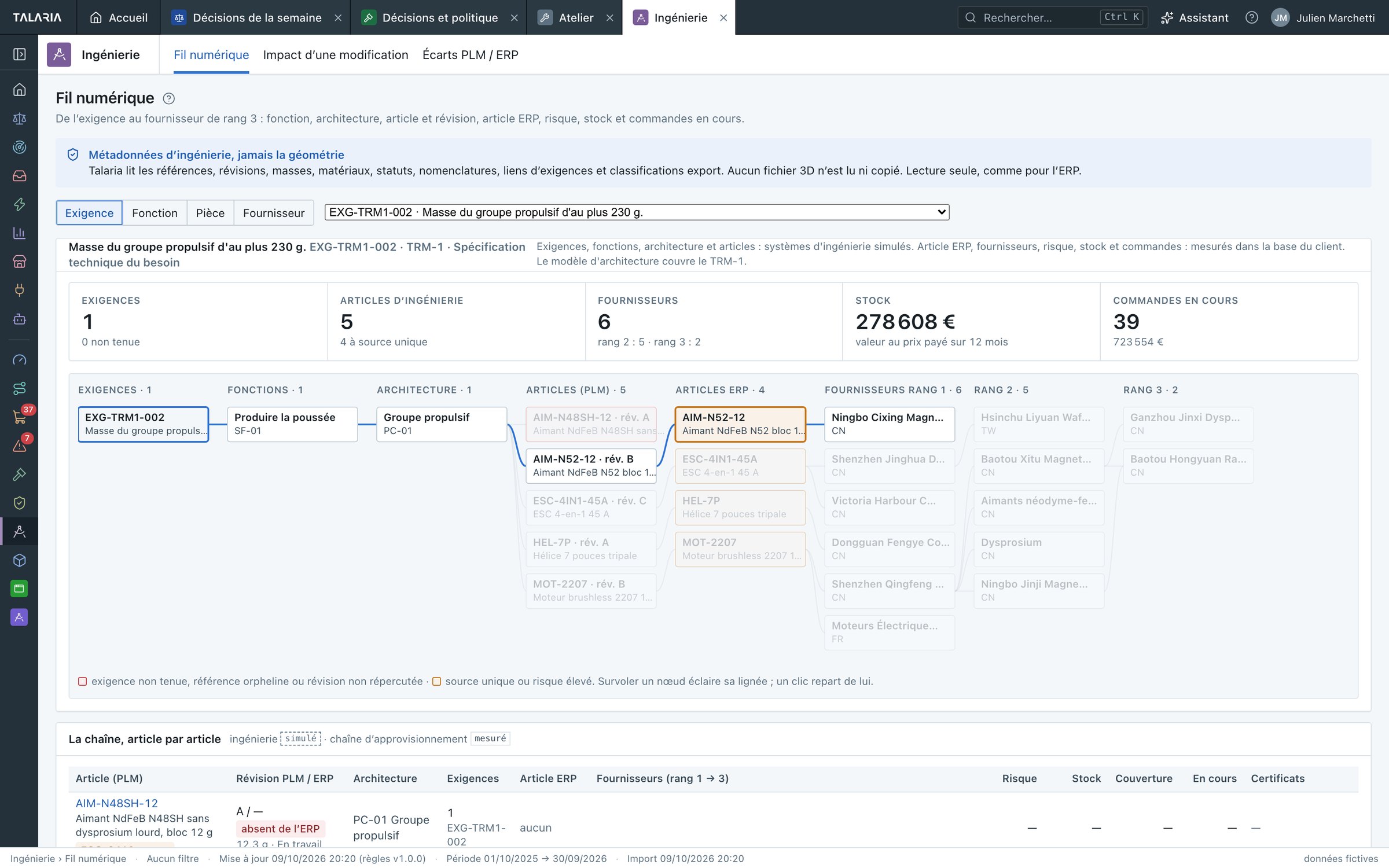
  8. From the engineering requirement to the tier-3 supplier, without leaving one model.

    What you see

    The requirement, the function, the architecture, the item, the ERP, the supplier: each step linked to the next.

    What you do

    You start from a supplier in difficulty and find the requirements it affects, or the other way round.

    What it changes

    Talaria reads metadata, never geometry: your drawings stay with you.

Demo data, fictitious client.

01 / 03

Talaria does the analysis to inform your teams’ decisions.

Connect

Talaria reads your software where it is, read-only: the ERP, purchasing, quality, contracts, your suppliers’ files. Each piece of data becomes an object of your business, a material, a component, a supplier, a site, an order, linked to what depends on it down to tier 3. What is declared, inferred or still unknown stays distinct.

Anticipate

An announced delay, a restricted material, a supplier growing fragile: Talaria follows the event through the model, from the part to the site, then to the customer order. Alerts arrive in a single queue, already quantified and ranked by what is at stake, in euros. Every figure can be traced to the data behind it.

Decide

For each alert, the possible responses are computed and compared side by side, with their assumptions and worst case. Talaria recommends and says why. Your teams choose, through their usual circuit. Talaria then prepares the file and records the decision, with its expected and then observed gain.

Every decision rests with a person

Talaria recommends; it never arbitrates. A person approves every action, through your usual circuit, after seeing the figures that justify it. Nothing is written to your systems without your approval, and every decision is kept in the register, with its options and its reason.

Your data stays in France, on our servers or on an instance dedicated to you. Artificial intelligence explains and proposes; it runs on our own servers. No data is entrusted to a third party: never drawings or embedded software.

A capability this critical must be built

on your own data,

for those who decide,

and under sovereign control.

Talaria brings all three together.

Let’s talk about your needs.

Twenty minutes to understand, then two months of access on your own data.

Get a quote